Price Movement
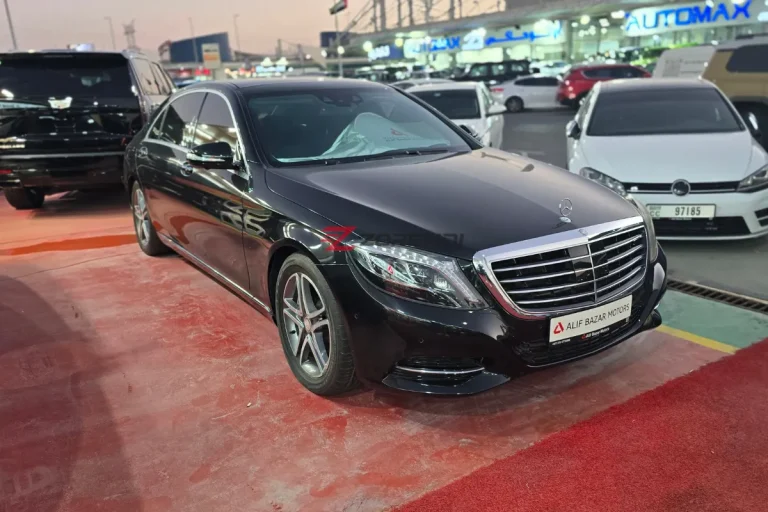
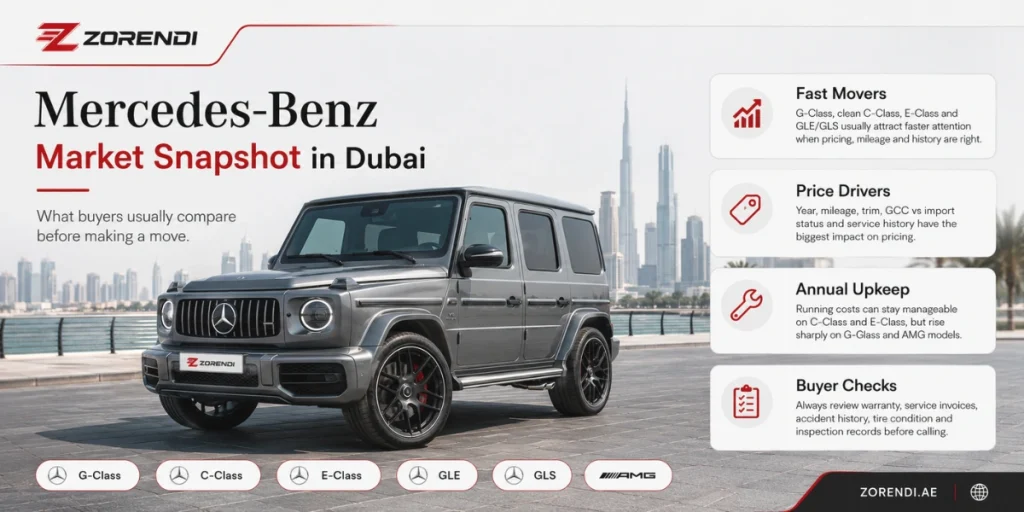
Mercedes-Benz prices in Dubai usually move with year, mileage, trim and GCC or imported specification. G-Class and clean SUVs can hold stronger prices, while sedans often become more sensitive to mileage and option packages.
{{locationDetails}}
{{locationDetails}}
You start noticing a pattern after watching Mercedes Benz listings long enough in Dubai. The cars that look underpriced rarely feel convincing once you compare them properly. And the ones that feel right almost never look like a deal at first.
That gap between price and confidence is where most decisions actually happen.
Read More: Unveiling the 2025 Mercedes Benz Vision Iconic Concept
Mercedes-Benz listings in Dubai cover very different buyer groups, from daily sedans and family SUVs to AMG performance models and G-Class status cars. Price behavior usually depends on model year, mileage, trim, service history and whether the car is GCC specs or imported.
| Popular Model | Typical Buyer Type | Price Behavior | Demand Level | Best Use Case | Market Notes |
|---|---|---|---|---|---|
| Mercedes-Benz G-Class Luxury SUV Icon | Buyers looking for status, strong road presence and long-term resale visibility. Often compared with Range Rover, Lexus LX, Defender and high-spec luxury SUVs. | Prices stay strong when mileage is low, color is desirable and the car has GCC specs. Brabus-style upgrades can help or hurt depending on quality. | High | Best for buyers who want a luxury SUV with image, resale strength and everyday usability in Dubai. | GCC examples usually attract stronger confidence. Imported cars need clean records, accident history clarity and proper inspection. |
| Mercedes-Benz S-Class Executive Luxury | Business owners, executives, chauffeur-use buyers and luxury sedan shoppers who care about comfort, cabin quality and prestige. | Depreciation is stronger than G-Class, especially after the first few years. Low mileage, high options and clean service history improve demand. | Medium | Ideal for executive driving, premium daily use, airport transfers and buyers who value comfort over sportiness. | Long-wheelbase versions, interior condition and option packages matter. Imported cars without history can face slower buyer response. |
| Mercedes-Benz C-Class Daily Premium Sedan | Young professionals, first-time luxury buyers and daily drivers comparing it with BMW 3 Series, Audi A4 and Lexus IS. | Prices are mileage-sensitive and trim-sensitive. Clean GCC cars with reasonable mileage usually get better attention than heavily used examples. | High | Best for city driving, daily commuting and buyers wanting a premium badge without large running costs. | AMG-line packages, interior condition and service history help listings stand out. High mileage can quickly push buyers toward alternatives. |
| Mercedes-Benz E-Class Balanced Executive Choice | Buyers who want more comfort and maturity than C-Class but do not need the size or cost of an S-Class. | E-Class values usually sit in a stable middle zone. Strong condition and GCC specs make pricing easier to justify. | High | Strong option for daily executive use, family driving and buyers who want comfort with manageable ownership costs. | Mileage and service records matter more than aggressive styling. Clean, well-kept examples usually perform better in listings. |
| Mercedes-Benz GLE / GLS Family Luxury SUV | Families, school-run buyers and luxury SUV shoppers who need space, comfort and a premium badge. | Prices shift based on seating configuration, trim, mileage and warranty. Newer GCC examples usually have stronger buyer confidence. | High | Best for family use, daily comfort, long drives and buyers comparing premium SUVs in Dubai. | Seven-seat GLS versions can attract family buyers quickly. GLE Coupe demand is more style-driven and can depend heavily on color and spec. |
| Mercedes-AMG Models Performance Buyer Pool | Enthusiast buyers looking for stronger engines, sportier styling and a more emotional driving experience than standard Mercedes-Benz models. | AMG pricing depends heavily on condition, mileage, modifications and service history. Clean stock cars often attract more serious buyers. | Selective | Best for buyers who want performance, sound, styling and a more special ownership experience. | Modified cars need careful inspection. Buyers usually check tires, brakes, accident history, ECU tuning signs and warranty status before contact. |
Mercedes-Benz prices in Dubai are strongly affected by model family. G-Class and clean SUVs often hold attention better, while sedans depend more on mileage, options, service history and how close the price sits to newer alternatives.
Before comparing only the asking price, check GCC or imported status, service records, accident history, warranty, mileage consistency, trim level and whether the car has non-factory modifications.
Mercedes-Benz price behavior in Dubai isn’t linear, it’s psychological. A 2019 E300 priced around 122K with 85,000 km can move faster than a 2020 one at 110K with 130,000 km, even though the second one looks like the better deal. The cheaper car doesn’t always attract more buyers.
Mileage only leads the conversation until condition and spec interrupt it. Once a car feels slightly off, buyers assign risk immediately, and that discount stops working. In many cases, the higher-priced car feels easier to justify because it answers questions before they’re asked.
Most buyers misread Mercedes Benz listings in Dubai in the same way.
They assume lower mileage equals better value, which is lazy and ignores how these cars are actually maintained
They overlook spec differences, especially AMG line versus base trims, and that assumption breaks quickly once they compare cars side by side
They treat imports as interchangeable with GCC cars if the price looks right, which rarely holds under inspection
They believe all Mercedes Benz cars deliver the same premium feel, ignoring how wide the gap really is between trims
Read More: Mercedes-Benz CLA 250 Coupé Full Review
Mercedes-Benz buyers in Dubai compare more than the badge. Model year, mileage, trim level, GCC or imported status, warranty, service history and body style can change how quickly a listing gets serious enquiries.
Mercedes-Benz prices in Dubai usually move with year, mileage, trim and GCC or imported specification. G-Class and clean SUVs can hold stronger prices, while sedans often become more sensitive to mileage and option packages.
G-Class, clean C-Class, E-Class and family SUVs like GLE or GLS usually attract faster attention when the price is realistic. Low mileage, GCC specs, good photos and clear service records make buyers respond quicker.
Mercedes-Benz listings can sit longer when the mileage is high, the color is unusual, the trim is weak, or the car is imported without proper history. Modified AMG cars can also become slower if buyers worry about maintenance.
Before contacting the seller, buyers should check GCC or import status, service records, accident history, warranty coverage, mileage consistency, tire condition, brake wear and whether the car has non-factory modifications.
The demand split is clear once you track movement. Mid-tier buyers move quickly on E Class and GLC models that feel balanced and easy to explain to themselves. High-end buyers focus on G63 or well kept S-Class units, but only when everything about the listing aligns cleanly.
Base trims don’t move as expected. Not because they’re bad.
Because they don’t match what buyers are actually searching for.
That’s where hesitation builds.
Cheap listings often look convincing until someone actually sees the car. Some are priced low because they need work, others because the spec doesn’t carry weight in person. That’s where most “good deals” quietly disappear.
Meanwhile, expensive listings continue to sell when they remove uncertainty early. Clear history, proper spec, and consistency between photos and reality matter more than the number itself.
A real deal is the one that holds together under pressure.
Read More: Mercedes G63 AMG Specs and Price in dubai
Mercedes-Benz annual maintenance cost in Dubai changes heavily by model family. A C-Class used as a daily car will not carry the same running-cost profile as a G-Class, S-Class, GLS or AMG model, especially once mileage, warranty status and service history are compared.
The C-Class is usually one of the more manageable Mercedes-Benz models to maintain in Dubai. Costs stay reasonable when the car has clean service records, normal mileage and no major electronic or suspension issues.
The E-Class sits in a balanced ownership zone. It can be comfortable and reliable as a daily executive car, but higher mileage, air suspension and electronic features can increase annual running costs.
The G-Class has strong demand in Dubai, but it is not a cheap SUV to keep properly. Tires, brakes, suspension components, service intervals and cosmetic upkeep can make annual costs noticeably higher.
The S-Class carries more technology, comfort systems and luxury components than smaller sedans. Air suspension, electronics, interior features and cooling-related checks can make ownership more sensitive to condition.
GLE and GLS models are popular family SUVs, but their weight and size affect tires, brakes and suspension wear. Seven-seat GLS examples can cost more to maintain when mileage is high or warranty coverage has ended.
AMG models can be the most expensive Mercedes-Benz cars to maintain, especially with performance brakes, wider tires, engine stress, previous tuning or signs of aggressive driving. Clean stock examples usually feel safer to buyers.
Mercedes-Benz maintenance is not equal across the range. Smaller sedans are usually easier to budget for, while G-Class, S-Class, GLS and AMG models can become more expensive because of larger parts, heavier wear, advanced electronics and more complex suspension systems.
Ask for service invoices, warranty details, tire age, brake condition, accident history, mileage consistency, suspension condition and whether the car has been modified or tuned before judging the listing only by price.

The pattern becomes consistent across models and price points. Buyers don’t chase the lowest number, they chase the version that feels complete with the least resistance. When comparing listings side by side, the cars that win are the ones that reduce doubt before the buyer even asks questions.
That’s not about price. It’s about alignment.
Because lower price alone doesn’t solve buyer hesitation. In many cases, it creates more suspicion than interest. What looks like a deal online often feels uncertain in person, and that slows everything down.
It matters, but not in isolation. Buyers react more strongly to condition and spec once they see multiple listings. A slightly higher mileage car with clarity can outperform a lower mileage one that raises questions.
Often, yes, because they remove uncertainty early. Even when imports appear cheaper, buyers tend to question them more aggressively. That hesitation alone changes how fast a car sells.
Because they match what buyers expect the brand to feel like. Base models can look like good value, but they often feel incomplete next to better-spec cars. That mismatch slows demand.
The real test happens after comparison and inspection. Many listings seem attractive until you start checking consistency between price, condition, and spec. The ones that still make sense after that are the real deals.
Because they reduce friction. When everything aligns clearly, buyers don’t need to negotiate aggressively or second-guess their decision. That clarity often beats a lower price with hidden uncertainty.