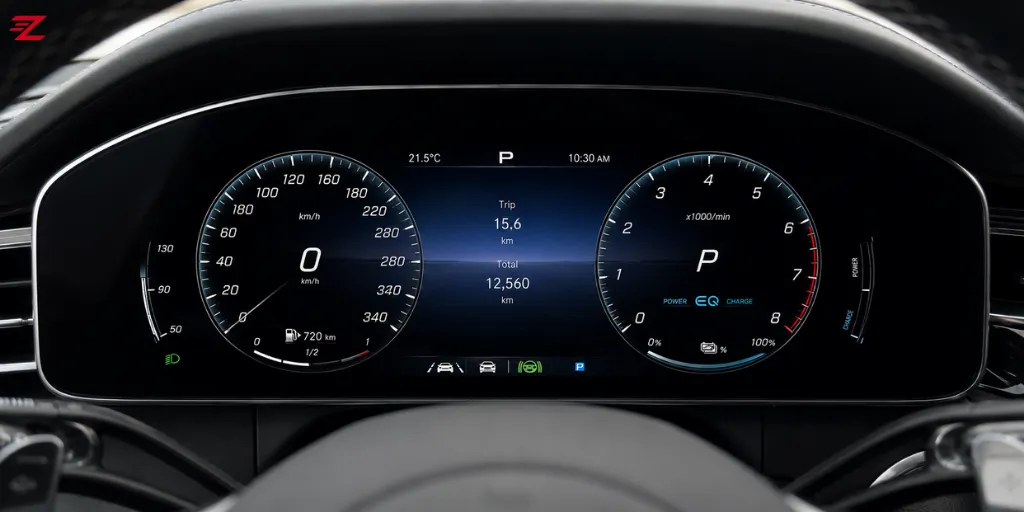
No — 100,000 km is not too much for a used car in the UAE, and for most cars it’s close to the local average, not a warning sign. Because of long highway commutes and minimal cold-climate wear, the best mileage range for used cars UAE buyers should actually target works out to roughly 15,000–25,000 km per year of the car’s age. A 5-year-old car sitting at 100,000 km fits squarely inside that range. What should concern you more than the odometer reading is the car’s service history, ownership pattern, and whether it spent time in a rental or taxi fleet.
Mileage rules of thumb from colder, more congested markets don’t transfer cleanly here. In the UK or continental Europe, a car covering 10,000–15,000 km a year is considered typical; in the US, it’s closer to 19,000–21,000 km. The UAE runs meaningfully higher than both. Used-car market data consistently shows vehicles here averaging close to 79,000 km on the odometer overall nearly double the roughly 47,000 km global average and a typical five-year-old car in the local market sits around 103,900 km.
That comparison reframes the whole question. A “high mileage” threshold borrowed from a UK buying guide will flag almost every well-used UAE car as suspicious, when locally it’s completely ordinary. The figure that should make you pause isn’t 100,000 km in isolation it’s 100,000 km on a car that’s only 18 months old, since that points to commercial use (rental, ride-hailing, or fleet) rather than a personal daily driver.

Three factors push UAE annual mileage well above the global norm:
Together, these push the typical UAE driver to 18,000–25,000 km a year heavy use almost anywhere else.
The odometer number alone does not confirm whether a car is good or bad. The real question is how the car was serviced, driven, and repaired during those kilometers.
Regular oil changes, gearbox service, brake work, cooling system checks, and agency or specialist invoices can support the car’s value.
Steering wheel shine, seat wear, pedals, buttons, tyres, and suspension noise should look consistent with the claimed kilometer reading.

Mileage alone tells you distance, not condition. Before you decide, check these five things they predict reliability far better than the odometer does on its own.
Service history. A full, stamped (or app-based) service record, ideally from an authorized dealer or reputable garage, shows the car was maintained on schedule regardless of distance covered.
Single owner vs. multiple owners. One owner who kept up with maintenance usually beats three owners in four years, even if the multi-owner car shows fewer kilometers frequent resale is itself worth investigating.
Highway km vs. city km. Steady highway driving is comparatively gentle on an engine; it holds optimal operating temperature, with less of the cold-start and stop-start wear that’s harder on components per kilometer.
Fleet, rental, or taxi history. Check the Mulkiya (registration card) for the vehicle’s classification. A car previously used as a rental or taxi can rack up mileage quickly under harder use.
Climate-related wear. Sustained extreme heat is hard on AC compressors, rubber hoses and seals, and batteries independent of distance driven. A low-mileage car left sitting through several summers can carry more heat-related wear than a higher-mileage car driven and maintained consistently.
Before finalizing a purchase, it’s also worth confirming the vehicle’s inspection and transfer status directly with the Roads and Transport Authority. Any car older than three years needs a valid RTA technical inspection pass before ownership can be transferred into your name, and that process flags major safety issues a casual test drive won’t catch.

Use this as a reference point, not a rulebook it’s built around the higher UAE driving averages discussed above.
Use this guide to understand whether a used car’s mileage is normal or higher than expected.
Crossing into the “watch out” column isn’t an automatic dealbreaker it just means you should dig into service history and prior use before negotiating, rather than walking away on the number alone. Notice where 100,000 km lands: a red flag at 3 years, but squarely normal by 5.
Ready to start comparing listings? Browse our car for sale listings with full service history.
It sounds counterintuitive, but a steady 100,000 km can be more reassuring than a suspiciously low one. A car that covered roughly 20,000 km a year on highway commutes, with one owner and a complete service record, often has less hidden wear than a car showing only 30,000 km after five years because that low figure frequently means long stretches sitting unused. Rubber perishes, fuel systems gum up, batteries degrade, and seals dry out in Gulf heat whether or not the car is actually being driven. Consistent use with documentation tends to beat low mileage with a blank history.
What Red Flags Should You Check, Regardless of Mileage?
Use this quick checklist before buying a used car in Dubai. The more boxes you can tick, the stronger the mileage story becomes.
Start ticking the items above to estimate how reliable the mileage story looks.
Not checked yet
100,000 km is not, by itself, a reason to walk away from a used car in Dubai. In a market where the average five-year-old car already carries roughly that figure, it sits inside the normal mileage range for used cars in the UAE not a warning sign. What decides whether that specific car is a good buy is everything the odometer can’t tell you: service history, ownership pattern, and how not just how far it was driven.
ALSO READ: How to Sell Your Car Fast in Dubai Without Losing MoneyZorendi Editorial Team is the editorial team behind Zorendi, covering cars, motorcycles, luxury vehicles, automotive technology, and mobility trends across the UAE and international markets.
Our articles are developed through research, comparison of reliable sources, official manufacturer information, vehicle specifications, and relevant market data. The team focuses on creating clear, practical, and regularly reviewed content to help readers better understand new models, specifications, technologies, ownership considerations, and developments across the automotive industry.
Zorendi Editorial Team aims to present information in a straightforward and useful way, with an emphasis on accuracy, relevance, and providing readers with the context they need when researching vehicles and mobility-related topics.
Word list
×