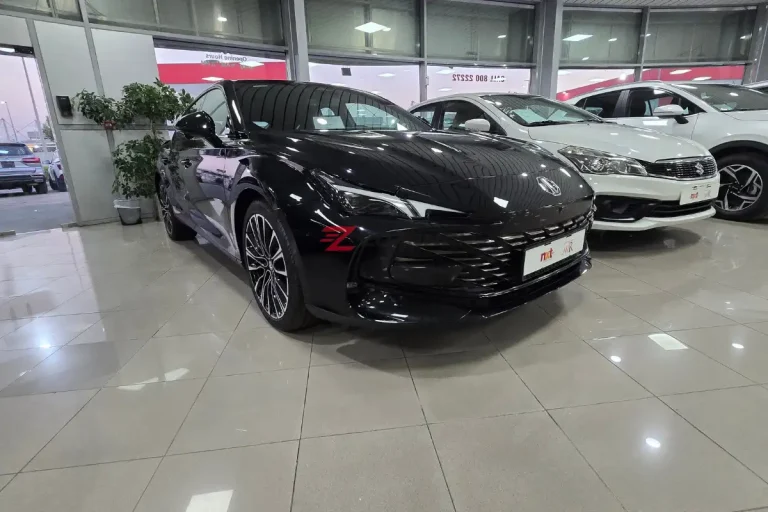
MG 7 for Sale in Dubai
The MG 7 occupies an unusual position in the UAE sedan market. Its price places it near mainstream models such as the Kia K5, Honda Accord and Toyota Camry, but its fastback body, frameless doors, active rear spoiler and available 261 horsepower engine give it a more performance-focused identity.
This is not simply a larger alternative to the MG GT. The MG 7 is longer, more powerful and noticeably more ambitious in its design and driving character. It targets buyers who want the road presence of a premium fastback without moving into the price range of a new Audi A5, BMW 4 Series Gran Coupe or Volkswagen Arteon.
For anyone searching for an MG 7 for sale in Dubai, the most important decision is not the exterior colour or interior package. It is choosing between the 1.5 litre turbocharged version and the considerably stronger 2.0 litre turbocharged model.
MG 7 Price in the UAE
The official MG UAE website currently advertises the MG 7 from AED 101,500. The model is also supported by MG's regional warranty of six years or 200,000 kilometres, whichever comes first.
Prices outside the official distributor network vary considerably. Current UAE advertisements include used 2025 examples from approximately AED 59,500, while cleaner GCC specification cars, higher trims and low-mileage 2.0 litre versions are commonly advertised between approximately AED 70,000 and AED 95,000. A new 2026 Trophy version with official dealer warranty has also been advertised at around AED 112,000.
The large difference between advertised prices does not mean that every AED 60,000 MG 7 is a bargain. Some vehicles have higher mileage, reduced warranty coverage, imported specifications or a different engine and equipment level. Trim descriptions such as STD, Deluxe, Luxury, Sport and Trophy are also used inconsistently across UAE advertisements.
A buyer should confirm the engine size, GCC specification, original invoice, warranty status and complete equipment list before comparing two cars by price.
The official specification confirms that the MG 7 is available with a 1.5 litre turbo engine producing 185 horsepower and 300 Nm, as well as a 2.0 litre turbo engine producing 261 horsepower and 405 Nm.
The Difference Between the MG 7 1.5T and 2.0T
The 1.5T gives buyers the MG 7 design at the lowest possible entry price. It has enough power for normal UAE driving and does not feel underpowered when joining city traffic or maintaining motorway speeds. Its 300 Nm of torque is available early enough to make it more responsive than many naturally aspirated sedans.
Its limitation appears when the driver asks for immediate acceleration at higher speeds. Overtaking between 100 and 120 km/h requires more planning, particularly when the car is carrying several passengers. The seven-speed dual-clutch transmission can also feel slightly less progressive when moving through slow traffic.
The 2.0T changes the nature of the car. With 261 horsepower, 405 Nm and a nine-speed automatic transmission, it offers performance that is difficult to find at a similar price. Published specifications place its zero to 100 km/h time at approximately 6.5 seconds.
The stronger engine gives the MG 7 enough acceleration to match its appearance. Throttle response is more convincing, motorway overtaking takes less effort and the nine-speed gearbox feels more appropriate for a large performance-oriented sedan.
The 2.0T is the version that makes the strongest case for buying an MG 7. The 1.5T is primarily a design and value choice. The 2.0T adds the performance required to make the fastback shape, active spoiler and sport-focused cabin feel justified.
Driving the MG 7 on Sheikh Zayed Road
Sheikh Zayed Road exposes the difference between the two engines quickly.
The 1.5T can maintain motorway speeds comfortably, but it needs a more deliberate accelerator input when changing lanes into faster traffic. It works well for a driver who normally stays within the traffic flow and values fuel economy over strong acceleration.
The 2.0T is better suited to the road. Its additional torque makes it easier to move around slower vehicles without waiting for a large gap. The nine-speed automatic also responds more naturally than the dual-clutch gearbox when speed changes repeatedly between busy junctions.
At motorway speed, the MG 7 feels planted rather than nervous. Its long wheelbase and low body help it remain stable through the sweeping sections between Downtown Dubai, Trade Centre and Dubai Marina.
The cabin is reasonably isolated from general traffic noise, although the 19-inch tyres produce more road sound on rougher surfaces. Wind noise is controlled well enough for normal conversation, but the MG 7 does not provide the same level of isolation as a significantly more expensive German premium sedan.
How It Feels on Al Khail Road and Dubai's Faster Routes
Al Khail Road suits the MG 7 more than congested inner-city roads. The wider lanes and longer curves allow its chassis to settle, while the stronger 2.0 litre engine can use its torque without constantly changing gears.
Higher versions are offered with an electronically controlled limited-slip differential and adaptive mCDC suspension. The differential manages power delivery through the front wheels, while the adaptive suspension changes damping according to the selected mode and road conditions.
These systems do not turn the MG 7 into a rear-wheel-drive sports sedan. It remains a front-wheel-drive car, and hard acceleration through a tight corner can still produce some steering influence from the driven wheels.
What the technology does provide is better traction, improved body control and more confidence through motorway curves. The car feels more controlled than its size and price suggest, especially in the 2.0T specification.
Comfort mode is the better choice for daily driving on Al Khail Road, Sheikh Mohammed bin Zayed Road and Emirates Road. The more aggressive setting increases response and body control, but it also makes the car feel busier over road joints and imperfect surfaces.
MG 7 in Downtown Dubai, Business Bay and Dubai Marina
The MG 7 looks more compact in photographs than it feels from behind the steering wheel. Its long body and wide stance create strong road presence, but they require more attention in tight parking entrances.
This becomes noticeable in older buildings around Dubai Marina, narrow basement parking areas in Business Bay and busy valet entrances around Downtown Dubai. A surround-view camera and parking sensors are valuable equipment rather than optional luxuries on a car of this size.
The steering is light at lower speeds, so the car is not difficult to position once the driver becomes familiar with its dimensions. Rear visibility is more restricted than in a conventional sedan because of the sloping fastback roof and raised rear bodywork.
The 1.5T dual-clutch transmission is most likely to reveal its weakness in stop-and-go traffic. At very low speeds, it can take a moment to engage and may not creep as smoothly as a torque-converter automatic. Smooth accelerator inputs reduce the effect, but drivers who spend every day in heavy traffic should test the car in realistic conditions before buying.
The nine-speed automatic in the 2.0T is easier to live with in the same situation. It moves away more progressively and reacts more naturally when traffic slows and accelerates repeatedly.
Ride Comfort on Jumeirah Road and Residential Streets
The MG 7 is not excessively hard, but comfort depends on the wheel size and suspension specification.
On smooth sections of Jumeirah Road, City Walk and Dubai Hills, the car feels composed and expensive enough for its market position. The suspension controls larger body movements well and does not allow the car to float after road dips.
Sharp speed humps, damaged surfaces and raised road joints are more noticeable through the 19-inch wheels. The impact is controlled rather than severe, but drivers expecting the soft ride of a traditional family sedan may find the MG 7 firmer than a Toyota Camry.
The adaptive suspension available on higher versions improves the balance between comfort and control. It cannot remove the effect of low-profile tyres, but it gives the car a broader range of behaviour than a fixed sport suspension.
The seats are supportive enough for longer journeys, although the low roofline slightly reduces the sense of space in the rear. Tall passengers should check rear headroom in person. Legroom is generally more generous than the exterior styling suggests.
Interior Quality and Everyday Use
The MG 7 cabin is designed around the driver rather than arranged like a traditional family sedan. The displays are positioned across the dashboard, the steering wheel has a flat lower section and the controls create a sportier atmosphere than the interiors of most similarly priced rivals.
Official specifications include a 12.3-inch central display, a 10.25-inch digital instrument cluster, multiple drive modes, smartphone integration and multi-colour ambient lighting.
The interior makes a strong first impression, particularly at night when the ambient lighting and digital displays become more prominent. The material quality is convincing in the areas the driver touches frequently, although some lower sections of the cabin still use harder plastics.
The fastback tailgate is one of the MG 7's practical advantages. It opens with the rear glass and provides a much larger loading opening than a conventional sedan boot. Large suitcases, photography equipment and wider boxes are easier to load than they would be in a sedan with a narrow boot lid.
The sloping rear roofline creates the expected compromise. Rear visibility is limited, and the cabin does not feel as open as the interior of an Accord or Camry. Buyers who frequently carry tall adults should prioritise a rear-seat test rather than judging the car from its exterior dimensions.
Realistic Fuel Consumption in the UAE
Published figures place fuel consumption at approximately 6.9 litres per 100 kilometres for the 1.5T and around 8.5 litres per 100 kilometres for the 2.0T.
Those figures are unlikely to be repeated consistently in Dubai traffic with continuous air-conditioning use.
A realistic expectation for the 1.5T is approximately 8 to 9.5 litres per 100 kilometres in mixed UAE driving. Drivers spending most of their time in congested areas may see figures above 10 litres.
The 2.0T will generally use around 9.5 to 11.5 litres per 100 kilometres. Frequent use of the sport mode, hard acceleration and short city journeys can push consumption higher.
The difference is meaningful for a high-mileage driver, but it should not be the only factor in the decision. Choosing the 1.5T to save fuel while expecting the performance suggested by the MG 7's appearance may lead to disappointment.
MG 7 Maintenance Costs in Dubai
MG requires its petrol vehicles to be serviced every 10,000 kilometres or six months, whichever occurs first. Servicing through the authorised network helps maintain warranty validity and creates a more valuable service record for resale.
Routine MG 7 services are commonly estimated at approximately AED 500 to AED 1,000, although the final invoice depends on the service interval, required filters, fluids and dealer labour.
A sensible annual maintenance budget for a normally driven MG 7 is between AED 1,500 and AED 3,000 during a year containing only routine services. A year that includes brake components, tyres, battery replacement or a major scheduled service may cost between AED 3,500 and AED 6,000.
The 2.0T should be expected to cost slightly more over time. It has the more powerful engine, larger performance demands and additional chassis technology. Its 19-inch performance-oriented tyres are also more expensive than basic sedan tyres.
The six-year or 200,000-kilometre warranty provides useful protection against covered manufacturing defects. Normal wear items such as tyres, brake pads, filters, wiper blades and batteries have shorter or limited coverage and should not be treated as part of the full vehicle warranty.
Owners should not delay oil changes on either turbocharged engine. Correct engine oil, cooling system condition and transmission servicing become increasingly important in the UAE climate, particularly when the car spends long periods in heavy traffic with the air-conditioning operating continuously.
Is the MG 7 Expensive to Repair?
Routine maintenance is not unusually expensive for a turbocharged midsize sedan. The greater financial risk appears after an accident or after the warranty period.
The frameless doors, large digital displays, active spoiler, camera systems, adaptive suspension components and electronic driver-assistance equipment are more complex than the parts fitted to a basic sedan. Damage to these systems may cost more than a normal oil service or brake replacement.
Body parts may also require more time to source than equivalent parts for a Toyota Camry or Nissan Altima because fewer MG 7 vehicles are currently on UAE roads.
This does not make the car unsuitable for daily use. It means that comprehensive insurance, authorised servicing and a complete warranty record have greater value on the MG 7 than they would on a simpler economy sedan.
MG 7 Depreciation in the UAE
The MG 7 is still too new in the UAE to have a fully established five-year resale pattern. Current advertisements nevertheless show a clear difference between official new-car pricing and the asking prices of used 2025 vehicles.
The official starting price is AED 101,500, while many used 2025 examples are advertised between approximately AED 65,000 and AED 90,000 depending on mileage, specification and condition. DubiCars currently reports an average starting price of approximately AED 62,400 for used 2025 MG 7 listings.
These are asking prices rather than confirmed transaction values, but they suggest that early depreciation can be significant. A normally used example may lose approximately 20 to 30 percent of its purchase value during the first year. A vehicle purchased at full official price and sold quickly may lose more.
After three years, retaining approximately 50 to 60 percent of the original purchase price would be a reasonable expectation, although the result will depend on the growth of the MG dealer network, future new-car discounts and demand for used MG 7 models.
A 2.0T GCC specification car with full dealer history should be easier to sell than a lower-specification imported vehicle. Buyers are more likely to pay for the stronger engine because performance is one of the MG 7's main attractions.
A clean car purchased at a substantial dealer discount may produce a more acceptable ownership result than one purchased at the full advertised retail price. Negotiating the original transaction price is therefore one of the most effective ways to reduce depreciation risk.
Current UAE pricing places the Toyota Camry from AED 122,900, the Honda Accord from AED 114,900, the Kia K5 at approximately AED 102,900 to AED 120,000 and the Hongqi H5 from approximately AED 81,900.
The Camry is the logical choice for buyers who want predictable reliability and resale value. The Accord offers a more refined balance of comfort and driving response. The K5 competes closely with the MG 7 on styling and equipment.
The MG 7 becomes more attractive when performance and visual presence matter more than resale certainty. None of these rivals offers the same combination of a fastback tailgate, frameless-door appearance, active spoiler and 261 horsepower at a similar official price.
What to Check Before Buying a Used MG 7
A used MG 7 UAE listing should be checked carefully before the buyer compares it with a new car.
The first requirement is confirmation of the vehicle specification. A low advertised price may belong to a Chinese specification car, a 1.5T version or a vehicle with reduced warranty coverage. A GCC badge in the advertisement is not enough. The chassis number and warranty record should be confirmed through the authorised distributor.
The transmission should be tested when cold and after the car reaches operating temperature. The 1.5T dual-clutch gearbox should engage smoothly without excessive hesitation, vibration or warning messages. The nine-speed automatic in the 2.0T should change gears without harsh impacts.
Every electronic feature should be tested. This includes the active spoiler, cameras, parking sensors, digital displays, seat controls, air-conditioning, driver assistance systems, panoramic roof and ambient lighting.
The tyres should have matching specifications and similar production dates. Cheap replacement tyres can reduce grip and create more road noise, especially on the 2.0T.
A complete accident inspection is essential. Frameless doors and the fastback tailgate require accurate alignment. Poorly repaired bodywork can create wind noise, water leaks and uneven panel gaps.
Who Should Buy the MG 7?
The MG 7 suits a buyer who wants a car that looks significantly more expensive than an ordinary midsize sedan. It works particularly well for a young professional, business owner or couple who values design and performance but still needs four usable doors and a practical luggage area.
The 1.5T is appropriate for someone who wants the exterior and interior design at a lower purchase price. It is capable enough for ordinary commuting, but it should not be purchased with the expectation of serious performance.
The 2.0T is better for drivers who enjoy acceleration, regularly use Dubai's motorway network and want the car's mechanical character to match its appearance.
The MG 7 is less suitable for a buyer who plans to sell after a few months, depends heavily on guaranteed resale value or wants the simplest possible ownership experience. A Camry or Accord remains the safer financial decision for those priorities.
Is the MG 7 Worth Buying in Dubai?
The MG 7 offers more personality than most sedans near its price. It has a distinctive shape, a convincing driver-focused cabin and, in 2.0T form, enough performance to make daily driving genuinely interesting.
Its strongest version delivers 261 horsepower, a nine-speed automatic transmission and available chassis systems that are uncommon in this price category. The six-year or 200,000-kilometre warranty also reduces some of the risk associated with its mechanical and electronic complexity.
The compromise is depreciation. Used-market evidence already shows a meaningful price gap between new and nearly new examples. Buyers who negotiate a good initial price and keep the car for several years will be less exposed to this loss than buyers who purchase at full retail and sell quickly.
For the strongest overall experience, the MG 7 2.0T is the version to choose. The 1.5T delivers the same visual impact at a lower cost, but the 2.0T provides the power, gearbox response and road behaviour that make the MG 7 different from an ordinary family sedan.
Zorendi allows buyers to compare new and used MG 7 cars for sale in Dubai, review available engine and equipment specifications and assess asking prices across the UAE. Owners can also list an MG 7 for sale and connect with buyers searching for GCC specification vehicles with verified mileage and service history.